It’s been a while since we’ve posted any flashbacks from our Hawaiian homeschool. Since we’re almost to the end of our school year, and thus our blog, I’m going to throw a bunch your way now. You can start by clicking here with my token post on homeschool socialization or here to read about snorkeling under the stars or here and here for some delicious celestial snack ideas. Only 3 more weeks to go folks! Summer’s coming fast!
Tag: astronomy
Devo 28
“And I will show wonders in the heavens above and signs on the earth below, blood, and fire, and vapor of smoke; the sun shall be turned to darkness and the moon to blood, before the day of the Lord comes, the great and magnificent day. And it shall come to pass that everyone who calls upon the name of the Lord shall be saved.” Acts 2:19-21
I knew this post was coming. This week’s readings have been sitting here for 9 months waiting their turn. Why should I dread writing about the wrath of God if I need not dread His wrath? Perhaps because I know it is real. And it is coming. And I am partly to blame. God’s wrath is a result of my own sin. Because of my rebellion against His holiness, His wrath was first poured out on His willing and righteous Son, Jesus Christ. He bore my sin for me on the cross and therefore He bore the wrath of God against me.
But there’s more wrath to come. And this time Jesus will be the judge, not the condemned.
We did a quick overview of Revelation in a series of devotionals for the ladies up here, looking specifically at who Christ is and how He is worshipped in the vision John is given. I was so struck by the attributes God was being praised for; some expected and very present in our own worship like His holiness, eternality, sovereignty, sacrifice, salvation, power, and righteousness; and others, not-so-much, like His wrath, judgements, rewards, justice, truth, vengeance and destruction of the ungodly.
The Psalms are brimming with the same kind of worship we see in the book of Revelation, but some where along the line, certain elements of God’s nature seem to have fallen out of our praise vernacular. So if I’m going to spend an eternity worshipping God for these attributes, I should at least be able to take a few minutes to write about them.
It’s easy to say passages like Ezekiel 32:1-8 and Micah 3:1-8 are too graphic for our modern day sensibilities, but I’m pretty sure such bloody descriptions weren’t exactly standard Saturday Evening Post fare for the ancients either. That kind of brutality would be shocking to any generation of man. Any human at any time would quake at the threat of being flung into an open field to be food for the vultures and other beasts and then to have ones flesh strewn upon the mountains along with so many others the ravines are flowing with blood.
Sounds merciless, right? And yet that’s exactly the kind of horrid consequence my rebellion demands. That’s how ugly my sin is to the just and holy and righteous God who made me. But when God turned the full fury of His wrath onto my sin, it was His perfect and holy and righteous Son who voluntarily took the blow. The wrath of God poured out on Jesus Christ on the cross was merciless. And all God’s mercy was poured out on me instead.
So can I praise God for His wrath? Yes! Because it is a holy wrath and because He was willing to bear it Himself on the cross for me. But how can one escape the wrath that is to come? For surely, the same Christ who bore my sins in His own body on the tree, who was buried and who rose again and ascended into heaven, this same Christ is coming back as judge over all the earth.
Just as a star announced Christ’s first advent, the heavens will proclaim His second. But dear friend, you need not dread that coming. No, you can rejoice and welcome your King! Peter, one of the eyewitnesses to Jesus’ death and resurrection, proclaimed in Acts 2:21 that “it shall come to pass that everyone who calls on the name of the Lord shall be saved!” Now, you might have the same question that Peter’s listeners had, “What shall we do?” His answer was simple. Repent and you will be born again. Your sins will be forgiven and God’s loving mercy will be poured out on you. Then you, too, will have all the reason in the world to praise Him for His wrath for He will have born it for you. Joel 2:12,13, which Peter was quoting from says,
“Even now,” declares the Lord, “return to me with all your heart, with fasting, with weeping, and with mourning; and rend your hearts and not your garments.” Return to the Lord your God, for He is gracious and merciful, slow to anger, and abounding in steadfast love; and He relents from disaster.”
Tolle lege: God and Galileo by Block and Freeman
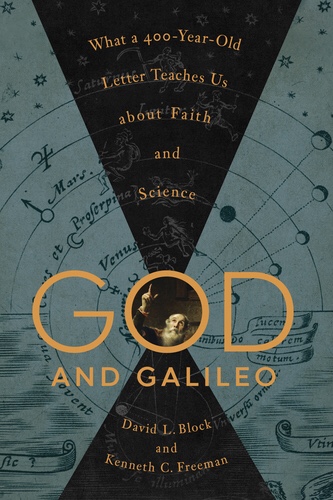
Well, it’s a fine quandary I’ve been put in. I was so excited to do a book review of God and Galileo by David Block and Kenneth Freeman (Crossway, 2019) because it seemed to combine two of my favorite subjects, theology and science.
Sadly, this book was neither a responsible treatment of either God or Galileo. Rather, it was a thinly veiled attempt to justify the authors deeply rooted evolutionary beliefs. By evolutionary, I don’t just mean the “a day is like a thousand years and a thousand years is like a day” variety. I mean the whole “big-bang produced stars produced carbon-based people” variety. Here’s an exact quote in case I got the order mixed up.
“For many different reasons, we could not live in a universe that was much smaller (or much hotter). First, enough time is needed for the hot big-bang universe to cool off, for matter to form, and then for the matter and radiation to decouple. Next, we are carbon-based human beings. Carbon is manufactured deep in the interiors of stars. Galaxies must first form, then stars within those galaxies must be born and complete their life cycles; the end products of the more massive stars are the exploding supernovae. It is these explosions that unlock carbon and heavier elements from stellar interiors into space, from which new stars are formed. As best we can understand it, this process—from the birth of the universe to us being here, orbiting a star that is enriched in carbon—takes billions of years (106).”
Now here’s my quandary. The authors have cleverly inserted a shield of defense within the text to prevent anyone outside of the field of science from criticizing their statements. The very first chapter contains this warning to any potential critics.
“Serious prejudices against the book of nature often stem from those whose exposure to the scientific method is limited. To be ‘well grounded in astronomical and physical science’ requires as much training as does psychiatry or neuroscience in the medical world. Astronomers would be foolish to pronounce on discoveries in neuroscience or psychiatry; we have not been trained in those specialties. Galileo’s letter demonstrates how crucial it is to be thoroughly grounded in astronomy before pronouncing on scientific discoveries. Paraphrasing Augustine’s message rather bluntly, don’t pontificate about matters that you do not understand 32-33).”
Should I, the reader, heed such a warning? Must I accept their statements as a matter of course based on the simple fact that they were made by experts in the field of astronomy? After all, I wouldn’t want to fall into the camp they describe here:
“Some with theological or political authority and no experience in science are ready to make judgments on the goals, methods, and conclusions of science. Instead, such individuals would be wise to adorn themselves with caution and humility in matters outside their realm of expertise (68-69).”
They continue,
“Science needs to be falsified by using the scientific method, not by simply quoting scriptures. This is indeed the thrust of Galileo’s entire letter to the Duchess, that it is the domain of scientists to verify or disprove scientific theories. It is not the place of theologians to falsify scientific ideas using bare scriptural arguments (79-80).”
Well there you have it. Only a bonafide scientist can dare question another scientist. This book contains a boatload of scientific theory, and I don’t just mean Galileo’s then-controversial heliocentric model. It is laden with current evolutionary cosmology. But it is not the job of the reader nor I dare say the publisher to question its content which is why, I suppose, Crossway did its humble duty in publishing it.
But it also contains a boatload of historical narrative, philosophical posturing, poetic waxing, and yes, theological pontificating. Sadly, I am an expert in none of those fields. So even though this book appeared to me oozing with logical fallacies, epistemological garbling, literary chatachresis, and theological error, I’ll humbly leave it to the experts in those fields to point it out to the authors.
 godmadeknown