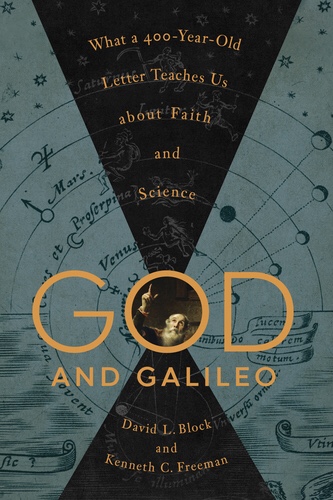
Well, it’s a fine quandary I’ve been put in. I was so excited to do a book review of God and Galileo by David Block and Kenneth Freeman (Crossway, 2019) because it seemed to combine two of my favorite subjects, theology and science.
Sadly, this book was neither a responsible treatment of either God or Galileo. Rather, it was a thinly veiled attempt to justify the authors deeply rooted evolutionary beliefs. By evolutionary, I don’t just mean the “a day is like a thousand years and a thousand years is like a day” variety. I mean the whole “big-bang produced stars produced carbon-based people” variety. Here’s an exact quote in case I got the order mixed up.
“For many different reasons, we could not live in a universe that was much smaller (or much hotter). First, enough time is needed for the hot big-bang universe to cool off, for matter to form, and then for the matter and radiation to decouple. Next, we are carbon-based human beings. Carbon is manufactured deep in the interiors of stars. Galaxies must first form, then stars within those galaxies must be born and complete their life cycles; the end products of the more massive stars are the exploding supernovae. It is these explosions that unlock carbon and heavier elements from stellar interiors into space, from which new stars are formed. As best we can understand it, this process—from the birth of the universe to us being here, orbiting a star that is enriched in carbon—takes billions of years (106).”
Now here’s my quandary. The authors have cleverly inserted a shield of defense within the text to prevent anyone outside of the field of science from criticizing their statements. The very first chapter contains this warning to any potential critics.
“Serious prejudices against the book of nature often stem from those whose exposure to the scientific method is limited. To be ‘well grounded in astronomical and physical science’ requires as much training as does psychiatry or neuroscience in the medical world. Astronomers would be foolish to pronounce on discoveries in neuroscience or psychiatry; we have not been trained in those specialties. Galileo’s letter demonstrates how crucial it is to be thoroughly grounded in astronomy before pronouncing on scientific discoveries. Paraphrasing Augustine’s message rather bluntly, don’t pontificate about matters that you do not understand 32-33).”
Should I, the reader, heed such a warning? Must I accept their statements as a matter of course based on the simple fact that they were made by experts in the field of astronomy? After all, I wouldn’t want to fall into the camp they describe here:
“Some with theological or political authority and no experience in science are ready to make judgments on the goals, methods, and conclusions of science. Instead, such individuals would be wise to adorn themselves with caution and humility in matters outside their realm of expertise (68-69).”
They continue,
“Science needs to be falsified by using the scientific method, not by simply quoting scriptures. This is indeed the thrust of Galileo’s entire letter to the Duchess, that it is the domain of scientists to verify or disprove scientific theories. It is not the place of theologians to falsify scientific ideas using bare scriptural arguments (79-80).”
Well there you have it. Only a bonafide scientist can dare question another scientist. This book contains a boatload of scientific theory, and I don’t just mean Galileo’s then-controversial heliocentric model. It is laden with current evolutionary cosmology. But it is not the job of the reader nor I dare say the publisher to question its content which is why, I suppose, Crossway did its humble duty in publishing it.
But it also contains a boatload of historical narrative, philosophical posturing, poetic waxing, and yes, theological pontificating. Sadly, I am an expert in none of those fields. So even though this book appeared to me oozing with logical fallacies, epistemological garbling, literary chatachresis, and theological error, I’ll humbly leave it to the experts in those fields to point it out to the authors.


 godmadeknown