Friday Factoid Week 29

Hey Homeschoolers!  Don’t you know Hartland’s Homeschool Family Camp starts this Monday?!?!  Why haven’t you signed up yet?  What could be a better way to end the school year than together as a family worshipping the Creator, spending time in God’s word, attending creation-based science classes, engaging in countless outdoor activities in a beautiful mountain setting, enjoying meals around the table with other homeschooling families and not having to prepare or clean up after any of it?!?!  If you can’t make it this spring, we offer the same camp in the fall.  Just go to hartlandcamp.com for the details. And do I need to remind you that Mother’s Day is this Sunday and wouldn’t she just love a week away from all her household duties?

This slideshow requires JavaScript.

This slideshow requires JavaScript.

Now, for you astronomy lovers, we’ve been studying space travel again so I’m posting this flashback from 6 years ago.  Also, while we were visiting Opa this week, we saw the first episode in a Netflix series called One Strange Rock by National Geographic.  In it 8 astronauts share their unique perspective on earth from space and then explore some aspect of the earth’s amazingly complex systems and how space exploration has aided us in discovering, observing or understanding it better.  It is spell binding!  You can’t walk away from it without praising our Creator for His amazing design.  Unless you’re actually involved in the movie.  Then, of course, you have to be careful to give all the credit to chance.

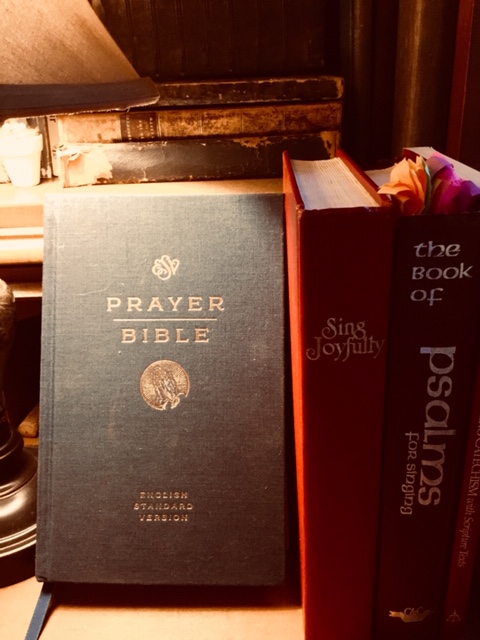
Tolle Lege: The ESV Prayer Bible

I grew up in an environment opposed to all things liturgical.  There was practically a liturgy developed out of being non-liturgical.  It was like, “Look, we’re so non-liturgical we do this other thing in this order every time we get together at this time instead, just to show how non-liturgical we are.”  Corporate prayers, confessions of faith, and the sacraments were viewed as remnants of Roman Catholicism and thus to be avoided at all costs.  Later in my mid-20’s my husband and I spent 7 years in a small inter-city Reformed Presbyterian Church and my eyes were opened to the value of liturgy through the confessions of faith and the singing of Psalms. The ancient beauty of the Psalter stood in such contrast to the filth and chaos all around us.  When we moved to Hawaii it was really hard to find a doctrinally sound church but the Lord led us to an aging congregation in the first and oldest church in the islands.  In general, the preaching was pretty bad, but at least we knew that the truth of the gospel would be proclaimed each Lord’s Day through the liturgy.  There would be hymns, the Apostles creed, the Lord’s Prayer, the benediction and then the doxology and the Queen’s Prayer sung in Hawaiian.  I learned to love liturgy there because I knew that my kids were learning great doctrinal truths through those repetitious means.  There is just something so Psalm 148:12 about your kids’ young voices joined with the elderly in these historical forms of worship.

But I still had a hang-up about written prayers.  Two things recently changed the way I viewed the value of composed prayers.  The first was in my thirst for understanding the Word of God.  I started praying segments of Psalm 119 each time I sat down to read scripture and then transposing them into the plural form when we’d gather as a group to study.  The second, was in reading the book of Revelation and the corporate worship of the living creatures, the elders,  the angels, and all the saints and wanting my own worship to be in accord with what was already and will be taking place around the throne.  Why are we so willing to sing lyrics written by another in worship but so opposed to repeating words written by another in prayer?  

The ESV Prayer Bible (Crossway, 2018) arrived at my door in the middle of these contemplations.  Here’s how it’s different from other Bibles.  It’s in single column format, which I love, and has prayers inserted throughout which correspond to the text.  These are written by a variety of Christians from the first century all the way into the 20th.  I think the most contemporary was Henry Wotherspoon of Scotland who died in 1930.  There are several index’s in the back including an author index and an index of the 400+ scripture passages that include a corresponding prayer.  My favorite index is a list of every passage of scripture that either is a prayer or references the subject. THAT is a feature I have already put to good use as I explore this topic further.

If you already have a rich and plentiful prayer life this Bible will only enhance that by reading these prayers in a Biblical context.  If, like me, you are wanting to grow your prayer life, this could be an invaluable resource.  The disciples themselves knew their own deficiencies in this area and asked Jesus in Luke 11:1, “Lord, teach us to pray.”  Paul confirms this in Romans 8:26, “We do not know what to pray for as we aught, but the Spirit himself intercedes for us with groaning too deep for words.”  This friends, is NOT given as an excuse not to pray.  Rather it should encourage us to participate more fully through the work of the Spirit in our own hearts teaching us to pray more in accordance with God’s will, just as Jesus modeled for us.  Paul says, “we aught” to know how to pray!  This book contains many examples worthy of our emulation. 

IMG_4114

A final point.  Prayers like the ones included in this Bible are a fantastic tool for training up our children in the faith.  They, like the confessions, creeds, and historical hymns, can be great instructors in right doctrine.  For that reason, I think children can be the greatest benefactors of our liturgies and yet most have sadly been robbed of this instructive form of worship.  I highly recommend this Bible for use in family devotions.  Take an extra minute when you come across a prayer to read the short author’s bio in the back.  It will add a historical continuity to the faith you are instructing your children in.  And while you’re at it, why not throw in a Psalm or hymn or a little catechesis?  

IMG_4115

(Although I was provided with a free copy of this book from the publisher I am under no obligation to write a favorable review)

Devo 29

“Arise, shine, for your light has come, and the glory of the Lord has risen upon you.  For behold, darkness shall cover the earth, and thick darkness the peoples;  but the Lord will Arise upon you, and His glory will be seen upon you.  And nations shall come to your light, and kings to the brightness of your rising.” —Isaiah 60:1-3

I just had to throw that passage in one more time since it precedes this week’s memory verse.  AND because it puts a lump in my throat every time I read it.  The Light has come, friend, and HE IS RISEN!  But where did the Light go?  In John 8:12-20, Jesus said, “I am the light of the world.  Whoever follows me will not walk in darkness, but will have the light of life.”  Three of His followers actually witnessed the manifestation of that glory in the transfiguration of Christ which we read about in Matthew 17:12-20.  In this passage Jesus articulates what was about to happen to the Light.  He was going to die and rise again. Later in John 8, Jesus says that He is going somewhere that those who are dead in their sins cannot come, somewhere not of this world.  That somewhere is exactly what Isaiah is describing in Isaiah 60:19,20:

“The sun shall be no more your light by day, nor for brightness shall the moon give you light; but the Lord will be your everlasting light, and your God will be your glory.  Your sun shall no more go down, nor your moon withdraw itself;  for the Lord will be your everlasting light, and your days of mourning shall be ended.”

Our final week of study is going to focus a lot more on the ultimate fulfillment of that prophecy, so this devo is actually just a teaser for week 31 when we’ll be diving into the book of Revelation 🙂  But I want to leave you with this quote from the same Apostle John who was one of the witnesses to the transfiguration of Jesus Christ and who was later given the vision of the city to come where that same Lord whom he saw crucified, risen and ascended into glory will reign as our everlasting light.  

“This is the message we have heard from Him and proclaim to you, that God is light and in Him is no darkness at all.   If we say we have fellowship with Him while we walk in darkness, we lie and do not practice the truth.  But if we walk in the light, as He is in the light, we have fellowship with one another, and the blood of Jesus His Son cleanses us from all sin.  If we say we have no sin, we deceive ourselves, and the truth is not in us.  If we confess our sins, He is faithful and just to forgive us our sins and to cleanse us from all unrighteousness (1 John 1:5-9).”

That’s a lot of ifs, so lets break them down.

IF we say we’re Christians but are walking in darkness, 

THEN we’re lying.

IF we are truly walking with Christ in the light, 

THEN we will be in fellowship with other Christians

AND the blood of Jesus has cleansed us from all our sins!

IF we say that we’re not sinners,

THEN we’re lying.

IF we confess our sins,

THEN He’ll forgive us and cleanse us from unrighteousness!

That’s the Gospel folks.   There’s darkness and there’s light.  There’s fellowship with Christ and His church and there’s not. 

There’s confession and forgiveness and the righteousness that comes from being cleansed from your sins and there’s living a lie.  There are no grey areas when it comes to salvation.

Oh friend, has that light shone on you?  Have you come to the brightness of His rising?  It’s there in black and white.  If you confess to Christ that you are a sinner in need of His forgiveness, He who is faithful and just will cleanse you from all your unrighteousness.