Tag: reformed theology

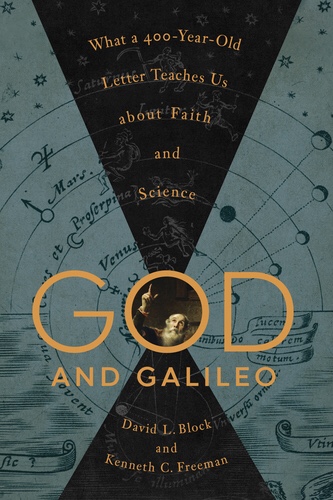
Tolle lege: God and Galileo by Block and Freeman

Well, it’s a fine quandary I’ve been put in.  I was so excited to do a book review of God and Galileo by David Block and Kenneth Freeman (Crossway, 2019) because it seemed to combine two of my favorite subjects, theology and science.

Sadly, this book was neither a responsible treatment of either God or Galileo.  Rather, it was a thinly veiled attempt to justify the authors deeply rooted evolutionary beliefs.  By evolutionary, I don’t just mean the “a day is like a thousand years and a thousand years is like a day” variety.  I mean the whole “big-bang produced stars produced carbon-based people” variety.  Here’s an exact quote in case I got the order mixed up.

“For many different reasons, we could not live in a universe that was much smaller (or much hotter).  First, enough time is needed for the hot big-bang universe to cool off, for matter to form, and then for the matter and radiation to decouple.  Next, we are carbon-based human beings.  Carbon is manufactured deep in the interiors of stars.  Galaxies must first form, then stars within those galaxies must be born and complete their life cycles; the end products of the more massive stars are the exploding supernovae.  It is these explosions that unlock carbon and heavier elements from stellar interiors into space, from which new stars are formed.  As best we can understand it, this process—from the birth of the universe to us being here, orbiting a star that is enriched in carbon—takes billions of years (106).”

Now here’s my quandary.  The authors have cleverly inserted a shield of defense within the text to prevent anyone outside of the field of science from criticizing their statements.  The very first chapter contains this warning to any potential critics.

“Serious prejudices against the book of nature often stem from those whose exposure to the scientific method is limited.  To be ‘well grounded in astronomical and physical science’ requires as much training as does psychiatry or neuroscience in the medical world.  Astronomers would be foolish to pronounce on discoveries in neuroscience or psychiatry;  we have not been trained in those specialties.  Galileo’s letter demonstrates how crucial it is to be thoroughly grounded in astronomy before pronouncing on scientific discoveries.  Paraphrasing Augustine’s message rather bluntly, don’t pontificate about matters that you do not understand 32-33).”

Should I, the reader, heed such a warning?  Must I accept their statements as a matter of course based on the simple fact that they were made by experts in the field of astronomy?  After all, I wouldn’t want to fall into the camp they describe here:

“Some with theological or political authority and no experience in science are ready to make judgments on the goals, methods, and conclusions of science.  Instead, such individuals would be wise to adorn themselves with caution and humility in matters outside their realm of expertise (68-69).”

They continue,

“Science needs to be falsified by using the scientific method, not by simply quoting scriptures.  This is indeed the thrust of Galileo’s entire letter to the Duchess, that it is the domain of scientists to verify or disprove scientific theories.  It is not the place of theologians to falsify scientific ideas using bare scriptural arguments (79-80).”

Well there you have it.  Only a bonafide scientist can dare question another scientist.  This book contains a boatload of scientific theory, and I don’t just mean Galileo’s then-controversial heliocentric model.  It is laden with current evolutionary cosmology.  But it is not the job of the reader nor I dare say the publisher to question its content which is why, I suppose, Crossway did its humble duty in publishing it.

But it also contains a boatload of historical narrative, philosophical posturing, poetic waxing, and yes, theological pontificating.  Sadly, I am an expert in none of those fields.  So even though this book appeared to me oozing with logical fallacies, epistemological garbling, literary chatachresis, and theological error, I’ll humbly leave it to the experts in those fields to point it out to the authors.

Friday Factoid Week 27

So we’ve been celebrating International Astronomy Month pretty hard around here and as it comes to a close I wanted to share cool milestone for our blog. This month Ecuador became the 100th country to visit Godmadeknown!


This slideshow requires JavaScript.

This year we’ve been going through the book “Operation World” and praying for each of the countries that our blog has reached. Praise the Lord for technology that can carry the Gospel to unreached places of the world! But more importantly, can you join us in praying for the real live people who are giving up everything and actually taking the good news of Jesus Christ to these countries? I can think of no better way to celebrate International Astronomy Month than in joining in prayer for others around the world to come to a saving faith in the Creator of all those amazing stars!

Devo 27

“And we have this prophetic word more fully confirmed, to which you will do well to pay attention as to a lamp shining in a dark place, until the day dawns and the morning star rises in your hearts.”  2 Peter 1:19

Have you ever felt yourself in a dark place?  Friend, even without feeling it, without Christ you are there now!  So please, pay attention!  I’m about to shine a lamp for you and Lord willing daylight will dawn, and the Bright and Morning Star will rise in your heart. You see, without Christ, your situation is just like that of the Israelites in Isaiah 59:2,3.

“Your iniquities have made a separation between you and your God, and your sins have hidden HIs face from you so that He does not hear. For your hands are defiled with blood and your fingers with iniquity;  your lips have spoken lies; your tongue mutters wickedness.”  

In verse 9-13 Isaiah describes clearly the human condition because of our sin.

“We hope for light, and behold, darkness, and for brightness, but we walk in gloom. We grope for the wall like the blind; we grope like those who have no eyes… We hope for justice, but there is none; for salvation, but it is far from us.  For our transgressions are multiplied before You, and our sins testify against us;  for our transgressions are with us, and we know our iniquities: transgressing, and denying the Lord, and turning back from following our God, speaking oppression and revolt, conceiving and uttering from the heart lying words.”

This is a dark and hopeless situation indeed.  But Isaiah continues and offers the very kind of illuminating and hope-filled prophetic word Peter was confirming in the passage above.  In verse 16, God affirms that due to fallenness of our nature there is not a single thing we can do to make things right with Him.  So get this.  “His own arm brought him salvation.”  He knew we couldn’t save ourselves so He came down and made atonement for us.  But how?  The very next chapter in Isaiah gives us a hint of what’s to come.

“Arise, shine, for your light has come, and the glory of the Lord has risen upon you.  For behold, darkness shall cover the earth, and thick darkness the peoples;  but the Lord will arise upon you, and His glory will be seen upon you.  And nations shall come to your light, and kings to the brightness of your rising.”

First, Jesus Christ, the very Son of God, was born in human form.  Right before that a man name John was born who was appointed to

“go before the Lord to prepare His ways, to give knowledge of salvation to His people in the forgiveness of their sins, because of the tender mercy of our God, whereby the sunrise shall visit us from on high to give light to those who sit in darkness and in the shadow of  death.”

Next, Jesus lived a perfect sinless life, fulfilling the righteous requirements of God in every way thus becoming the spotless lamb, willing and able to give His life as a sacrifice for all who lived in rebellion against Him.  The Son of God handed over His body to be brutally beaten and hung on a Roman cross, a laughing stock to those He came to save.  And as he He hung there, this rejected Savior of man, this forsaken Son of God, thick darkness came over the land.  He died.  He was buried.

Three days later, after the sun had risen, Jesus’ friends came to His tomb.  But THE SON had RISEN!  Not only had He conquered sin, He had beaten death!  And He offers that same sin slaying, death destroying power of new, everlasting life to all who trust in His righteousness alone as the means by which they can stand before a holy, wrathful, and yet graciously merciful God.

Do you see this lamp shining, showing you the only way out of your eternal peril?  Has the Son of God, the Bright Morning Star risen in your own heart?  He IS risen, friend.  He IS risen indeed.  And He’s coming again as judge.  Are you ready to stand before His soul- penetrating light in life or in death?  Today can be the day of salvation for you!  Call on Jesus and be saved!