Tag: crossway

Tolle lege: God and Galileo by Block and Freeman

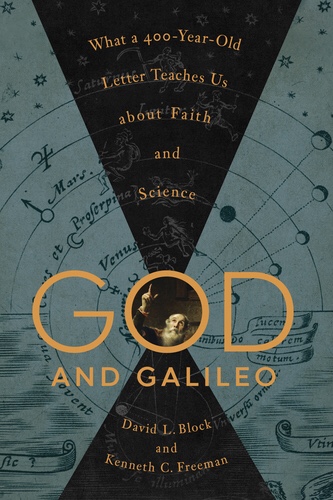
Well, it’s a fine quandary I’ve been put in.  I was so excited to do a book review of God and Galileo by David Block and Kenneth Freeman (Crossway, 2019) because it seemed to combine two of my favorite subjects, theology and science.

Sadly, this book was neither a responsible treatment of either God or Galileo.  Rather, it was a thinly veiled attempt to justify the authors deeply rooted evolutionary beliefs.  By evolutionary, I don’t just mean the “a day is like a thousand years and a thousand years is like a day” variety.  I mean the whole “big-bang produced stars produced carbon-based people” variety.  Here’s an exact quote in case I got the order mixed up.

“For many different reasons, we could not live in a universe that was much smaller (or much hotter).  First, enough time is needed for the hot big-bang universe to cool off, for matter to form, and then for the matter and radiation to decouple.  Next, we are carbon-based human beings.  Carbon is manufactured deep in the interiors of stars.  Galaxies must first form, then stars within those galaxies must be born and complete their life cycles; the end products of the more massive stars are the exploding supernovae.  It is these explosions that unlock carbon and heavier elements from stellar interiors into space, from which new stars are formed.  As best we can understand it, this process—from the birth of the universe to us being here, orbiting a star that is enriched in carbon—takes billions of years (106).”

Now here’s my quandary.  The authors have cleverly inserted a shield of defense within the text to prevent anyone outside of the field of science from criticizing their statements.  The very first chapter contains this warning to any potential critics.

“Serious prejudices against the book of nature often stem from those whose exposure to the scientific method is limited.  To be ‘well grounded in astronomical and physical science’ requires as much training as does psychiatry or neuroscience in the medical world.  Astronomers would be foolish to pronounce on discoveries in neuroscience or psychiatry;  we have not been trained in those specialties.  Galileo’s letter demonstrates how crucial it is to be thoroughly grounded in astronomy before pronouncing on scientific discoveries.  Paraphrasing Augustine’s message rather bluntly, don’t pontificate about matters that you do not understand 32-33).”

Should I, the reader, heed such a warning?  Must I accept their statements as a matter of course based on the simple fact that they were made by experts in the field of astronomy?  After all, I wouldn’t want to fall into the camp they describe here:

“Some with theological or political authority and no experience in science are ready to make judgments on the goals, methods, and conclusions of science.  Instead, such individuals would be wise to adorn themselves with caution and humility in matters outside their realm of expertise (68-69).”

They continue,

“Science needs to be falsified by using the scientific method, not by simply quoting scriptures.  This is indeed the thrust of Galileo’s entire letter to the Duchess, that it is the domain of scientists to verify or disprove scientific theories.  It is not the place of theologians to falsify scientific ideas using bare scriptural arguments (79-80).”

Well there you have it.  Only a bonafide scientist can dare question another scientist.  This book contains a boatload of scientific theory, and I don’t just mean Galileo’s then-controversial heliocentric model.  It is laden with current evolutionary cosmology.  But it is not the job of the reader nor I dare say the publisher to question its content which is why, I suppose, Crossway did its humble duty in publishing it.

But it also contains a boatload of historical narrative, philosophical posturing, poetic waxing, and yes, theological pontificating.  Sadly, I am an expert in none of those fields.  So even though this book appeared to me oozing with logical fallacies, epistemological garbling, literary chatachresis, and theological error, I’ll humbly leave it to the experts in those fields to point it out to the authors.

Devo 21

“It is He who made the earth by His power, who established the world by His wisdom, and by His understanding stretched out the heavens.”  Jeremiah 51:15

The Aramaic translation of Genesis 1:1 reads,  “From the beginning with wisdom the Lord created and finished the heavens and the earth.”

The inclusion of wisdom’s presence at the time of creation is repeated several times in scripture.  Job hints at it in chapter 28.  He searches all over creation as a miner plumbs the depths of the earth for treasure but to no avail.  Until he considers the source of wisdom itself.  “God understands the way to it, and He knows its place.”  How so?  Because when He weighed the wind and measured the waters God saw wisdom, declared wisdom, established wisdom and searched it out (Job 28:23-27).  

So how can man attain this wisdom?  Is it by studying creation itself?  Only insomuch as one begins with God and a proper fear of Him.  Job concludes in verse 28, “Behold, the fear of the Lord, that is wisdom, and to turn away from evil is understanding.”  

Proverbs picks up on this same theme in chapter 3 verse 7 with the admonishment to “Be not wise in your own eyes; but fear the Lord, and turn away from evil.”  First fear, then wisdom.  Verses 19,20 continue on the wisdom at creation riff, 

“The Lord by wisdom, founded the earth; by understanding He established the heavens; by His knowledge the deeps broke open, and the clouds drop down the dew.”

Proverbs 8:12,13 further clarifies what the fear of the Lord is.  “I, wisdom, dwell with prudence, and I find knowledge and discretion.  The fear of the Lord is hatred of evil.”

Wow!  I never thought of the fear of the Lord in quite those terms before!  But it goes right along with the earlier Proverbs and Job passages, doesn’t it?  Do you seek wisdom?  Then fear God.  How? Hate evil and turn from it.  That’s the first step, and it’s a necessary one.

I want to quote one more long section of Proverbs 8 and then make a drastic departure from the usual form and function of these devos by way of application.  Verse 22 takes us back to the wisdom of God being present at the time of creation,

“The Lord possessed me at the beginning of His work, the first of His acts of old.  Ages ago I was set up, at the first, before the beginning of the earth.  When there were no depths I was brought forth…” And Wisdom goes on describing her presence at each point of creation, the dry land, the plants., etc…

“…When He established the heavens, I was there;  when He drew a circle on the face of the deep, when He made firm the skies above…”  Until finally, the culmination of all God’s creative activity, a living thing made in His own image.  Wisdom was there, too, “beside Him like a master workman, and I was daily His delight, rejoicing before Him always, rejoicing in His inhabited world and delighting in the children of man.

How amazing is that!  Wisdom rejoices to see God’s world inhabited, populated by image bearers.  Wisdom delights in the offspring of those image bearers, the children of man.  

And then Wisdom takes on a somber tone, “And now, O sons, listen to me…”. Do want to be wise and blessed and obtain favor from the Lord?  Then keep wisdom’s ways, hear instruction, do not neglect to listen, to watch and wait, “For whoever finds me finds LIFE,” but all who hate me love DEATH.

This passage shed an entirely new light on two recent readings of mine.  The first was the book on Christian Education by Ted Newell I did a review of last week, which you can click here to read, and the second is an article on the Born-Alive Abortion Survivors Protection Act which last week was voted down by 44 of our 47 Democrat Senators. Please take the time to read this important article by clicking here.

The connection of wisdom, and knowledge, and understanding to education is obvious.  But what does the wisdom of God in creation have to do with abortion?  And what do they all of these have to do with each other?

Let’s start with education.  IF the purpose of education is to impart wisdom, knowledge and understanding, and I acknowledge for many that is not the goal, but IF it is, then the beginning of, or foundation for, that education has to be the fear of the Lord.  According to the passages we’ve looked at today, the fear of the Lord is, or at the very least must include, a hatred of and turning away of evil.  Any truly Christian education has to build up from that foundation.  

Now, how does abortion tie into all that?  Proverbs 8:31 says that the wisdom of God delights in children, babies made in His image, and verse 35 promises that whoever finds wisdom will find life there.  But in the next verse we’re warned that those who fail to find the wisdom of God not only injure themselves but those who hate the wisdom of God actually love death.  

When I read the statistics about the products of our current forms of Christian education turning their backs on the doctrine of creation and thus, the very wisdom of God, and at the same time embracing the so called “right” to murder the most defenseless of God’s image bearers, not just in the womb, but now fully emerged, I read a failure to impart in the next generation the fear of the Lord.

The God who in His own power and by His own wisdom stretched out the heavens is INDEED a God to be feared!

Tolle Lege: ESV Gospel Transformation Study Bible

I feel hugely privileged to be able to write the following book review of the ESV Gospel Transformation Study Bible(Crossway, 2018).  It’s only been in my eager hands for a day, but I wanted to share my first impressions.  Before even opening my hard-cover copy, I’m already loving the promising subtitle, “Christ in All of Scripture, Grace for All of Life.”

Thumbing through, I’m excited to see that it’s in the same single-column format as my ESV Journaling Bible.  Once you experience that format it’s really hard to go back to the double-columns.  Of course that difficulty also applies to the ESV translation itself.  That was enough thumbing for me.  I wanted to dig right in.

The introduction makes clear right away what makes this Study Bible different from other Study Bibles.  Editor Bryan Chapell states their twofold goal as being, 

“(1) to enable readers to understand that the whole Bible is a unified message of the gospel of God’s grace culminating in Christ Jesus, and (2) to help believers apply this good news to their everyday lives in a heart-transforming way (vii).”

That statement is exactly why I wanted to get my hands on a copy of this Study Bible in particular.  I’m not a student of Study Bibles.  Even though we have several in the house, the last time I actually regularly studied the notes in one was back as a teenager when I had a copy of the NIV Student Bible.  In fact, a good portion of the doctrinal error from my formative years I can pretty much trace back to those notes.  Praise the Lord for ministries like The Gospel Coalition, Ligonier, Desiring God, and The Proclamation and Charles Simeon Trusts!  Not only did those resources help correct so much of the error I had been exposed to, through them I kept hearing that various authors, pastors, and teachers which I had come to respect had contributed notes to this volume.

So when I turned to page xvii and scanned the list of contributors, it was like walking into a room full of old friends.  Michael Horton, Kathleen Nielson, Elyse Fitzpatrick, Ray and Dane Ortlund, Graeme Goldsworthy, David Helm, Colin Smith, Nancy Guthrie,  Iain Dugoid, Kevin DeYoung, Burk Parsons, Dan Doriani, Vern Poythress… (xvi-xix)  Really?  You’re all here?  I’m imagining myself showing up to the Bible Study I was at tonight, only all my best and most learned friends have shown up too, and we get to study God’s Word together!  So what that none of these contributors know me from Adam?  I know they know Jesus, and have helped me immensely the past few years to see how all of scripture bears witness to Him (vii) and that scripture isn’t the Basic Instructions Before Leaving Earth of my Student Bible Days, but the amazing revelation of God to man concerning His Son, Jesus Christ and the salvation He grants to all who believe in His Name.  

Oh, and besides not knowing me from Adam, these contributors actually do have a pretty good handle on Adam, himself.  Since the ladies Bible study I’m in was studying Genesis 2 tonight, I took the opportunity to quickly check out the notes for that chapter.  And there was Jesus!  William VanGemeren (a brand new friend :), traces the story of Sabbath through scripture to Jesus Christ Himself, our Sabbath Rest (6).  I had to get to Bible Study, so I couldn’t read more, but that little morsel was enough for me to know what a feast would be awaiting me later on.  I really can’t wait for my next bite!

Although I was provided a free copy of this book through Crossway, I am under no obligation to write a positive review.