It was a joy to hold in my hands this week a book that I think makes up for that evolutionary bit of nonsense Crossway published earlier this year called “God and Galileo” by David Block and Kenneth Freeman (you can read that review here). What Block and Freeman claim Galileo’s 400-year-old letter teaches us about faith and science is that the one must bow to the other in matters of the physical universe. “Science needs to be falsified using the scientific method, not by simply quoting the Scriptures…It is the domain of scientists to verify or disprove scientific theories. It is not the place of theologians to falsify scientific ideas using bare scriptural arguments (80).” Even though this quote lies within the chapter titled “The Fraud of Scientism,” the book itself as a whole is just one grand example of the very thing they weakly identify as fraudulent. In fact, in rereading that chapter, I never was able to pinpoint a direct argument against scientism, other than their refutal of the current theory of a multiverse.
“God and Galileo” really serves to exemplify the kind of weak scientism that J. P. Moreland claims has crept into the church in his book “Scientism and Secularism” (Crossway, 2018). According to his definition, “Scientism is the view that the hard sciences—like chemistry, biology, physics, astronomy—provide the only genuine knowledge of reality (26).” Moreland further distinguishes between strong scientism, which “implies that something is true, rationally justified, or known if and only if it is a scientific claim that has been successfully tested and that is being used according to appropriate scientific methodology (29)” and weak scientism, which “acknowledges truths apart from science, granting them some minimal rational status even if they don’t have scientific support (30).” Block and Freeman do this very thing by making sharp distinctions between “the nature of truth and the truth of nature”(66), “intellectual discernment and spiritual discernment”(97), and “material and spiritual” systems (104). There is a book of Scripture and a book of nature (43) and “the book of nature can never be suppressed”(81). I would argue that Romans 1:18-23 suggests otherwise but I’ll leave the arguing to Moreland who does a far superior job than I ever could. Oh, and I must mention in speaking of Moreland’s superiority, that there are sections of his book I’ll have to go back and reread because they were honestly way over my head. I’m thinking specifically of chapters 7-9 which dealt with non scientific knowledge and first philosophy (pretty pathetic of me since I was a philosophy major but clearly I need to review).
Moreland’s greatest strength, and the thing that I think makes this book a necessary read, is that he not only puts forth a clear and thorough examination of scientism but how in its weaker form it has infiltrated the church. “Weak scientism, when believed and put into practice, leads to a constant revision of doctrines that the church has held for centuries under the pressure of scientistic political correctness (72).” The implications reach far beyond the origins and age of the universe affecting the foundations of human identity, gender, the nature of sin etc…(73). The effects of scientism have been marked and destructive and yet we’ve been practically incognizant of its presence, so subtle has been its infiltration. Moreland contends that truth need not be compartmentalized with science always taking the superior position over theology. There needs to be a reintegration of the Christian world view into every discipline. For too long, “Christians compartmentalized their faith, kept it tucked away in a private compartment of their lives, and did not integrate their Christian ideas with their work” (185).
This book serves as a huge encouragement for Christians who have been left grasping for reasons to have confidence in a Biblical worldview and courage in applying that worldview to all of life.

* Even though I was given a copy of this book by the publisher I am under no obligation to write a favorable review.


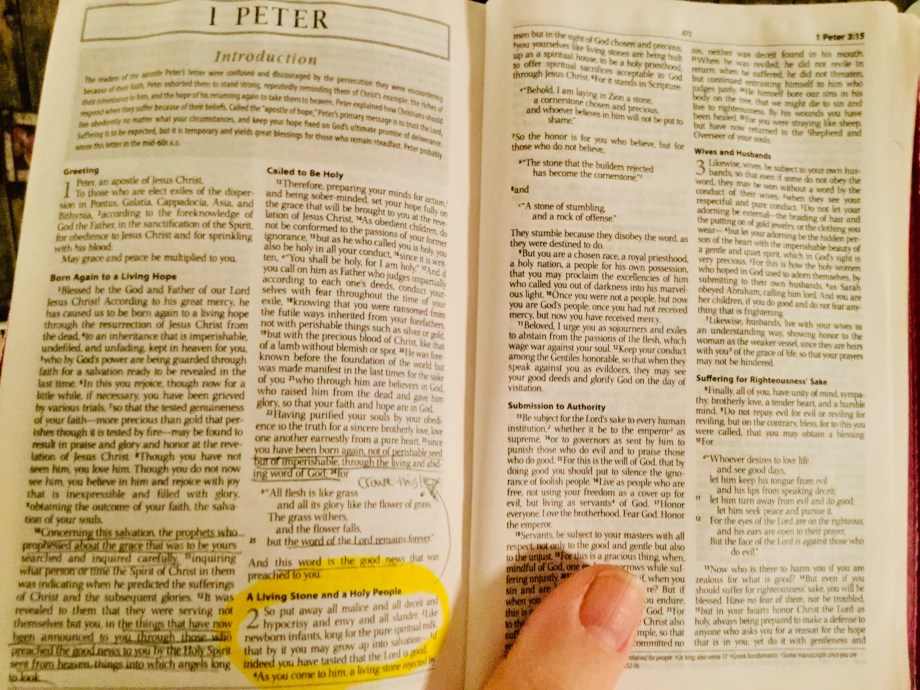 The tiny Bible pictured above is the second of its kind I owned. The first, which my husband gifted to me on the occasion of the birth of our first child, proved the perfect size to hold in one hand and read aloud to a nursing infant. Alas, it’s greatest strength proved it’s fatal flaw. That Bible accidentally ended up in the laundry immediately following the birth of our fourth child, the unfortunate victim (I mean the Bible, not the baby) of its own diminutive size versus the mountains of laundry a family with 4 boys under the age of 6 is bound to produce. The birth of our 5th son warranted the purchase of a nearly exact duplicate which I found equal to the task of being easy to hold with one hand while reading aloud to a nursing infant. Precious hours of nourishment for mommy and baby both.


 godmadeknown