Tag: book reviews

Tolle Lege: The ESV Prayer Bible

I grew up in an environment opposed to all things liturgical.  There was practically a liturgy developed out of being non-liturgical.  It was like, “Look, we’re so non-liturgical we do this other thing in this order every time we get together at this time instead, just to show how non-liturgical we are.”  Corporate prayers, confessions of faith, and the sacraments were viewed as remnants of Roman Catholicism and thus to be avoided at all costs.  Later in my mid-20’s my husband and I spent 7 years in a small inter-city Reformed Presbyterian Church and my eyes were opened to the value of liturgy through the confessions of faith and the singing of Psalms. The ancient beauty of the Psalter stood in such contrast to the filth and chaos all around us.  When we moved to Hawaii it was really hard to find a doctrinally sound church but the Lord led us to an aging congregation in the first and oldest church in the islands.  In general, the preaching was pretty bad, but at least we knew that the truth of the gospel would be proclaimed each Lord’s Day through the liturgy.  There would be hymns, the Apostles creed, the Lord’s Prayer, the benediction and then the doxology and the Queen’s Prayer sung in Hawaiian.  I learned to love liturgy there because I knew that my kids were learning great doctrinal truths through those repetitious means.  There is just something so Psalm 148:12 about your kids’ young voices joined with the elderly in these historical forms of worship.

But I still had a hang-up about written prayers.  Two things recently changed the way I viewed the value of composed prayers.  The first was in my thirst for understanding the Word of God.  I started praying segments of Psalm 119 each time I sat down to read scripture and then transposing them into the plural form when we’d gather as a group to study.  The second, was in reading the book of Revelation and the corporate worship of the living creatures, the elders,  the angels, and all the saints and wanting my own worship to be in accord with what was already and will be taking place around the throne.  Why are we so willing to sing lyrics written by another in worship but so opposed to repeating words written by another in prayer?  

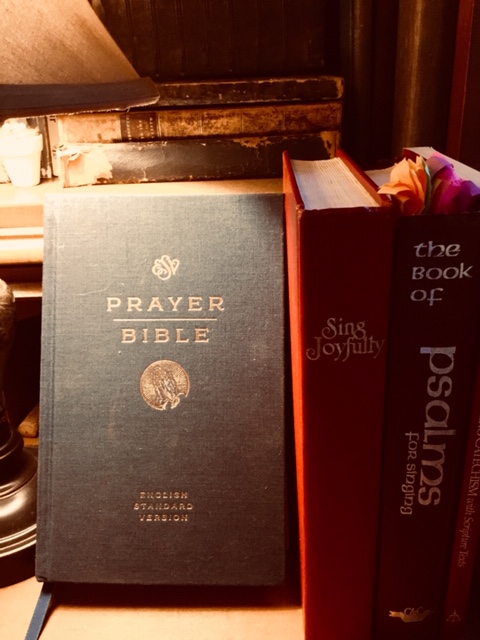
The ESV Prayer Bible (Crossway, 2018) arrived at my door in the middle of these contemplations.  Here’s how it’s different from other Bibles.  It’s in single column format, which I love, and has prayers inserted throughout which correspond to the text.  These are written by a variety of Christians from the first century all the way into the 20th.  I think the most contemporary was Henry Wotherspoon of Scotland who died in 1930.  There are several index’s in the back including an author index and an index of the 400+ scripture passages that include a corresponding prayer.  My favorite index is a list of every passage of scripture that either is a prayer or references the subject. THAT is a feature I have already put to good use as I explore this topic further.

If you already have a rich and plentiful prayer life this Bible will only enhance that by reading these prayers in a Biblical context.  If, like me, you are wanting to grow your prayer life, this could be an invaluable resource.  The disciples themselves knew their own deficiencies in this area and asked Jesus in Luke 11:1, “Lord, teach us to pray.”  Paul confirms this in Romans 8:26, “We do not know what to pray for as we aught, but the Spirit himself intercedes for us with groaning too deep for words.”  This friends, is NOT given as an excuse not to pray.  Rather it should encourage us to participate more fully through the work of the Spirit in our own hearts teaching us to pray more in accordance with God’s will, just as Jesus modeled for us.  Paul says, “we aught” to know how to pray!  This book contains many examples worthy of our emulation. 

IMG_4114

A final point.  Prayers like the ones included in this Bible are a fantastic tool for training up our children in the faith.  They, like the confessions, creeds, and historical hymns, can be great instructors in right doctrine.  For that reason, I think children can be the greatest benefactors of our liturgies and yet most have sadly been robbed of this instructive form of worship.  I highly recommend this Bible for use in family devotions.  Take an extra minute when you come across a prayer to read the short author’s bio in the back.  It will add a historical continuity to the faith you are instructing your children in.  And while you’re at it, why not throw in a Psalm or hymn or a little catechesis?  
IMG_4115

(Although I was provided with a free copy of this book from the publisher I am under no obligation to write a favorable review)
Tolle lege: God and Galileo by Block and Freeman

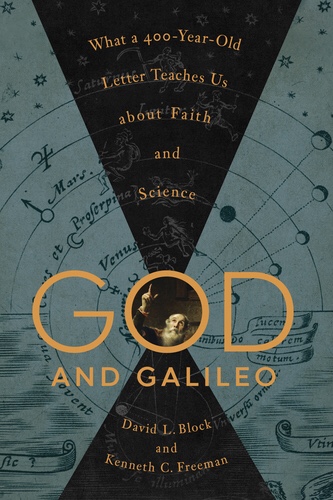
Well, it’s a fine quandary I’ve been put in.  I was so excited to do a book review of God and Galileo by David Block and Kenneth Freeman (Crossway, 2019) because it seemed to combine two of my favorite subjects, theology and science.

Sadly, this book was neither a responsible treatment of either God or Galileo.  Rather, it was a thinly veiled attempt to justify the authors deeply rooted evolutionary beliefs.  By evolutionary, I don’t just mean the “a day is like a thousand years and a thousand years is like a day” variety.  I mean the whole “big-bang produced stars produced carbon-based people” variety.  Here’s an exact quote in case I got the order mixed up.

“For many different reasons, we could not live in a universe that was much smaller (or much hotter).  First, enough time is needed for the hot big-bang universe to cool off, for matter to form, and then for the matter and radiation to decouple.  Next, we are carbon-based human beings.  Carbon is manufactured deep in the interiors of stars.  Galaxies must first form, then stars within those galaxies must be born and complete their life cycles; the end products of the more massive stars are the exploding supernovae.  It is these explosions that unlock carbon and heavier elements from stellar interiors into space, from which new stars are formed.  As best we can understand it, this process—from the birth of the universe to us being here, orbiting a star that is enriched in carbon—takes billions of years (106).”

Now here’s my quandary.  The authors have cleverly inserted a shield of defense within the text to prevent anyone outside of the field of science from criticizing their statements.  The very first chapter contains this warning to any potential critics.

“Serious prejudices against the book of nature often stem from those whose exposure to the scientific method is limited.  To be ‘well grounded in astronomical and physical science’ requires as much training as does psychiatry or neuroscience in the medical world.  Astronomers would be foolish to pronounce on discoveries in neuroscience or psychiatry;  we have not been trained in those specialties.  Galileo’s letter demonstrates how crucial it is to be thoroughly grounded in astronomy before pronouncing on scientific discoveries.  Paraphrasing Augustine’s message rather bluntly, don’t pontificate about matters that you do not understand 32-33).”

Should I, the reader, heed such a warning?  Must I accept their statements as a matter of course based on the simple fact that they were made by experts in the field of astronomy?  After all, I wouldn’t want to fall into the camp they describe here:

“Some with theological or political authority and no experience in science are ready to make judgments on the goals, methods, and conclusions of science.  Instead, such individuals would be wise to adorn themselves with caution and humility in matters outside their realm of expertise (68-69).”

They continue,

“Science needs to be falsified by using the scientific method, not by simply quoting scriptures.  This is indeed the thrust of Galileo’s entire letter to the Duchess, that it is the domain of scientists to verify or disprove scientific theories.  It is not the place of theologians to falsify scientific ideas using bare scriptural arguments (79-80).”

Well there you have it.  Only a bonafide scientist can dare question another scientist.  This book contains a boatload of scientific theory, and I don’t just mean Galileo’s then-controversial heliocentric model.  It is laden with current evolutionary cosmology.  But it is not the job of the reader nor I dare say the publisher to question its content which is why, I suppose, Crossway did its humble duty in publishing it.

But it also contains a boatload of historical narrative, philosophical posturing, poetic waxing, and yes, theological pontificating.  Sadly, I am an expert in none of those fields.  So even though this book appeared to me oozing with logical fallacies, epistemological garbling, literary chatachresis, and theological error, I’ll humbly leave it to the experts in those fields to point it out to the authors.

Tolle Lege: “Even Better Than Eden” AND “The City of God and the Goal of Creation”

As long as I can remember, Genesis has been my favorite book in the Bible.  I love starting each home-school year off with “In the beginning God…”  No matter what we’re studying, that’s where we start.  That’s where the foundation for each subject is laid.  Science, history, math, language arts—it all must build on that solid rock of scripture if it is to maintain any integrity within the Christian faith.  And yet, so often Genesis is left out of the building of the most important subject of all, theology.    

This past year I have fallen in love with Genesis even more.  Once your eyes are opened to the glories of Christ as revealed on every page of scripture it’s impossible to look away.  The book of Genesis from its very first words, sets the stage for the cosmic drama of redemption designed to put on display to all rulers and authorities in the heavenly places, the manifold wisdom of God (Eph.3:10).  Two books that I have read recently highlight major redemptive themes found in the book of Genesis and trace them throughout Scripture toward their ultimate consummation realized in Jesus Christ and the kingdom in which He reigns.  

img_3936

In “Even Better Than Eden”, (Crossway, 2018). Nancy Guthrie traces the themes of Wilderness, the Tree, God’s Image, Clothing, the Bridegroom, Sabbath, Offspring, Dwelling Place, and the City from the Garden of Eden through the Old Testament and into the New Kingdom established by Christ.  She argues that even though Eden was unsullied, it was incomplete.  “From the very beginning Eden was not meant to be static; it was headed somewhere (12).”  That somewhere is what both the Old and New Testament saints were looking forward to.

“You and I were meant to enjoy an environment, a sense of purpose and satisfaction, and an intimacy with God and each other that is even better than Adam and Eve enjoyed in Eden.  Eden had the seeds of the new creation, but all those seeds will burst into glorious bloom in the new heaven and the new earth.  When we enter the new Eden, our Sabbath rest, the final temple, the New Jerusalem, we’ll begin to experience all that God has intended for his people all along (159).”

The second book I read picks up on just one of those themes, the City, and fleshes it out in extraordinary detail.  T. Desmond Alexander is the author of “The City of God and the Goal of Creation” (Crossway, 2018).  This book is extremely helpful in understanding Jerusalem as the Temple-City, the Holy Mountain City, AND the Royal City as well as its archetype city, Babylon.  But the book really gets exciting in its last two chapters where it delves into the future City of God, the New Jerusalem.  Alexander argues that against the background of pre-fall Eden to post-fall Babel and beyond, 

“The biblical story recounts how God takes the initiative to redeem people from the grip of the Evil One, gradually establishing his kingdom on the earth… The Old Testament story of Israel’s redemption from slavery in Egypt begins a process that climaxes with God coming to dwell on Mount Zion.  This process provides a paradigm for understanding divine salvation, as God takes the initiative to create a holy temple-city.  The events that lead to the construction of the temple in Jerusalem illustrate something of what entails salvation and how it is achieved.  These events also anticipate a greater salvation that will come through a future Davidic king (164).” 

That may sound just a bit heady but Alexander follows through with a beautiful application on the very next page.

“For those who are united to Jesus Christ, eternal life begins here and now, as does citizenship of the city that will one day be created by God on a renewed earth.  Jesus challenges his followers to look forward in faith, to pray and work for the spread of God’s rule here and now (165).”

He concludes, 

“Jesus Christ calls his followers to be kingdom builders here and now, but they are to do this with the confident assurance that Christ will return to address every injustice as universal judge, vindicating and punishing as appropriate.  Only then with the defeat of evil will God establish New Jerusalem on a renewed earth (165).”